There is a layout mistake we see in roughly half of the new garage installations our readers send in. It looks like this. The owner buys a wall of cabinets. They install the cabinets. Then they put everything they own behind cabinet doors. And six months later, half the cabinets are empty, the other half are stuffed beyond capacity, and the things they actually use every day are sitting on the floor because there is nowhere to set them down without opening a cabinet.
This is the closed-storage trap. It happens because cabinets feel like the goal of garage organization, when they should be one part of a layered system. The actual goal is to match the storage type to the access frequency. Things you use weekly should be visible and reachable. Things you use yearly should be locked away in cabinets. Things you use never should be in overhead racks or off-site.
This piece is about the mix. We are going to talk about how cabinets and open storage work together as a single planned solution, and which Amazon products integrate the two layers most effectively.
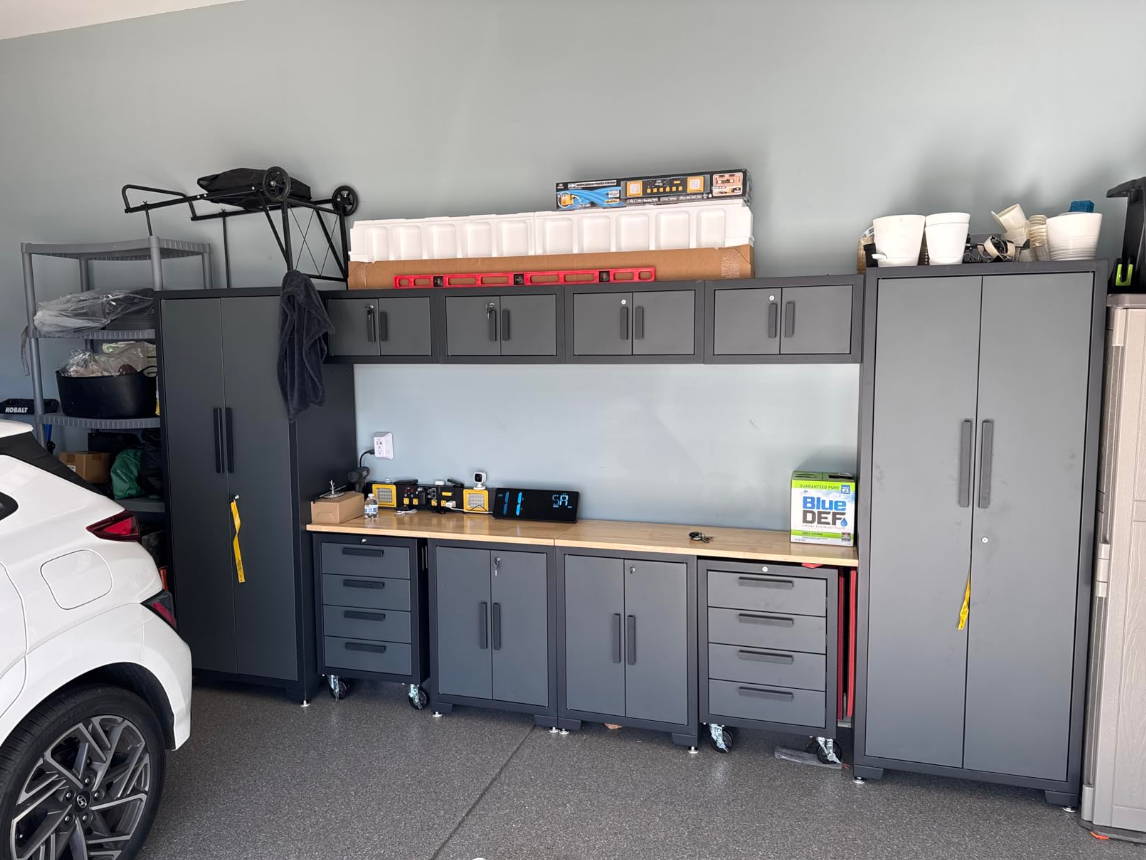
The photo above shows the layered approach in practice. Notice the wire rack to the left of the cabinet wall. That is open storage holding gear that gets accessed weekly. The cabinets behind closed doors hold items accessed monthly or less. The shelf above the cabinets, near the ceiling, holds bulk items accessed seasonally. Three different layers, three different access frequencies, all working in the same garage.
A garage that has only cabinets is not finished. It is one third of a finished garage.
The frequency-of-access framework
Before you choose products, choose frequencies. This is the single planning step that prevents the closed-storage trap, and it takes about ten minutes.
Walk through your garage and mentally categorize every category of stored item by how often you actually use it. Use the past twelve months as your data, not what you imagine you might use it for. Three categories cover almost everything.
Daily and weekly use covers tools you reach for during regular projects, gear you carry in and out (gym bags, sports equipment, dog supplies), and supplies you replenish often (cleaning products, motor oil, paper towels). This category should live in open storage. Pegboard, slatwall, wire racks, or open shelving. The friction of opening a cabinet door is enough to make weekly-access items end up on the floor instead of put away properly.
Monthly use covers seasonal-ish tools (lawn equipment, snow shovels in summer storage, holiday lights in offseason), specialty supplies (paint, automotive fluids, woodworking gear if you only craft sometimes), and bulk-bought consumables that you do not want to leave in plain sight. This category is the right home for cabinet storage. The cabinet doors keep the visual clutter down and the locks keep the bulk consumables from walking away.
Annual or rare use covers holiday decorations, off-season tires, camping gear if you camp twice a year, hand-me-down items for the next kid in the family. This category goes in overhead storage. Ceiling racks, platform storage, or the high shelves above the cabinet wall. You do not need to access these items conveniently. You need to access them once or twice a year and then forget about them.
Once you have your three categories sized, the cabinet question becomes simpler. You need cabinet capacity that matches your monthly-use volume, not your total garage volume.
The two-layer minimum: cabinets plus open storage
Even if you are not ready to buy overhead racks, every garage cabinet system should be paired with at least one form of open storage to handle the weekly-access layer. This is the layer most cabinet sets do not include and most buyers forget to plan for.
The three options for the open-storage layer are pegboard, slatwall, and wire shelving. Each has its place.
Pegboard is the cheapest option and the easiest to install. A four-by-eight sheet of one-quarter-inch pegboard from any home center costs under fifty dollars. The downside is that pegboard hooks pop out easily under load, and the pegboard itself does not hold up to garage humidity over time. Pegboard works for light tools (hand tools, hardware bins, hooks for cords) but not for heavy items.
Slatwall is the premium option. PVC slatwall panels rated for seventy-five pounds per square foot, paired with steel hooks and accessories, will hold serious weight. A typical eight-by-four section runs three to five hundred dollars including hardware. The advantage over pegboard is the load capacity and the long-term durability. The disadvantage is the cost.
Wire shelving is the option most cabinet buyers underestimate. A six-foot wide industrial wire shelving unit from a brand like Trinity or Edsal costs one hundred fifty to three hundred dollars and gives you three or four shelves of open storage that handles five hundred pounds per shelf. For garages with limited wall space available for slatwall, wire shelving is often the better answer. It uses floor space instead of wall space, and it handles bulkier items than slatwall accessories can hold.
Most well-organized garages we see use a combination. Slatwall above the workbench for tool organization. Wire shelving on a side wall for bulk supplies. Pegboard inside cabinet doors for additional small-tool capacity.
Which Amazon cabinet sets integrate the two layers best
The three Amazon cabinet sets we recommend deliver different amounts of the open-storage layer in the base purchase. This affects how much additional money you will spend after the cabinet purchase to complete the system.
HPDMC 15-Piece Corner System (Best Integration)
The HPDMC set is the only one of the three that includes open storage in the base purchase. Four pegboard panels mount between the wall cabinets and the worktops, giving you immediate organization surface for daily-access tools.
The pegboard panels are sized to the wall cabinets and finished to match the cabinet color. This is a meaningful improvement over buying pegboard separately and trying to make it look intentional. The integrated panels read as part of the cabinet system, not as an afterthought added later.
What HPDMC does not include is dedicated wire shelving or slatwall. The pegboard panels handle small tools well but they will not hold five-gallon buckets, large power tools, or bulk supplies. Plan to add wire shelving on a side wall regardless of which set you buy.
Check current HPDMC 15-Piece pricing on Amazon
Torin 12-Piece System (Workbench Integration)
Torin does not include pegboard or slatwall in the base purchase, but it includes a feature that none of the other sets integrate as well: a continuous wood worktop running the length of the cabinet bank.
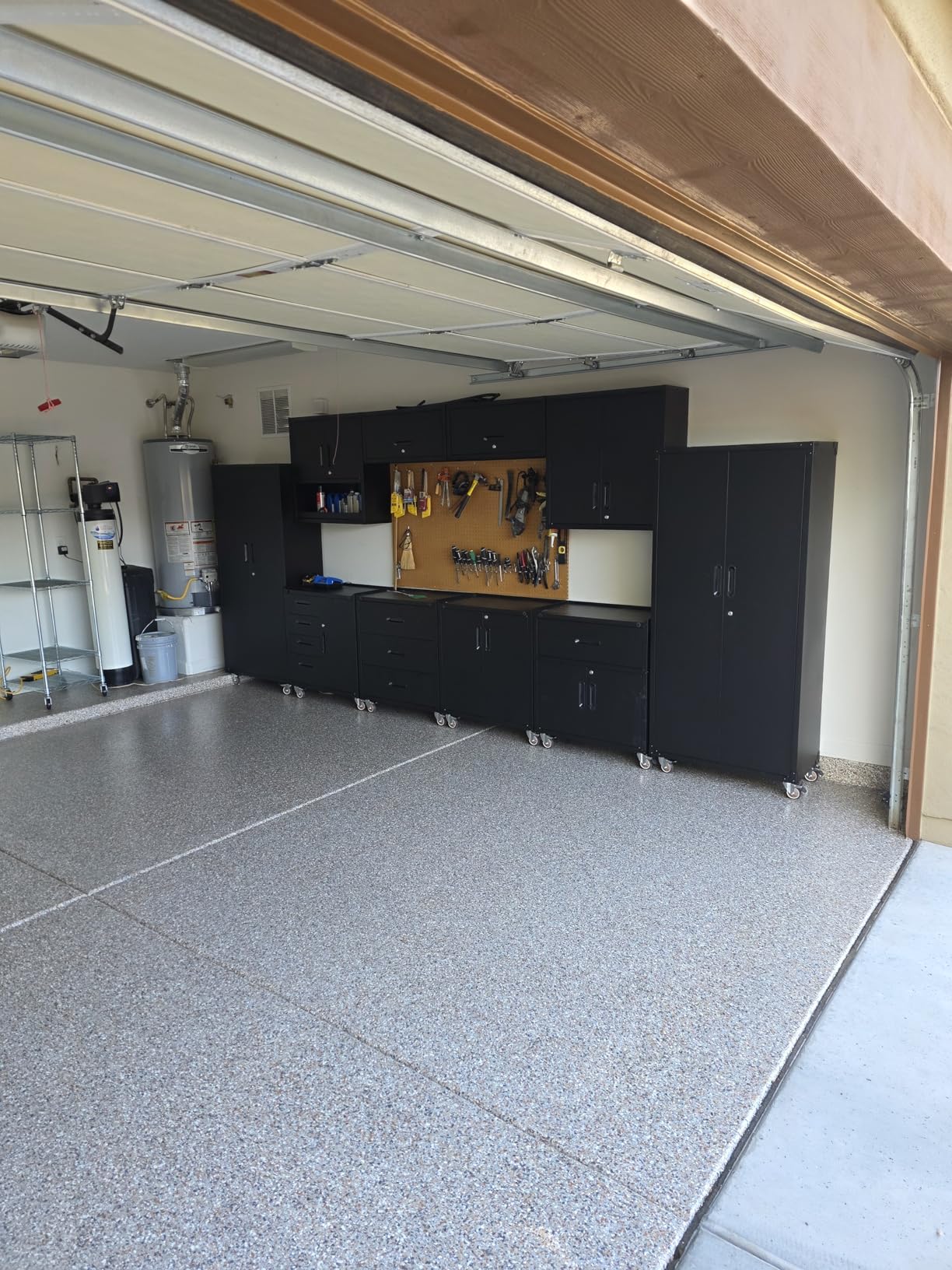
The worktop is the bridge between cabinet storage and open organization. Items you use during a project pull out of the rolling drawer chest, sit on the worktop while you work, and either go back in the drawer or get hung on slatwall above the worktop when the project is done. Without a continuous worktop, this workflow does not work — there is nowhere to set things down.
The Torin set is the right base if you plan to add a slatwall section above the worktop as a second-phase purchase. The wall space directly above the worktop is the highest-value real estate in any garage. A four-by-four-foot slatwall section there will hold ninety percent of your daily-use tools.
Check current Torin 12-Piece pricing on Amazon
VIYET 10-Piece System (Pure Cabinet Base)
VIYET is the most cabinet-focused of the three sets. Ten coordinated pieces of enclosed storage with no integrated open-storage layer at all. No pegboard, no worktop, no wire shelving.
This sounds like a disadvantage and at the system level it is. But there are buyers for whom it is the right answer. If you have a wall of existing pegboard from a previous garage installation, or if you have already purchased slatwall separately, or if you are deliberately phasing your system over multiple years, VIYET gives you the cabinet wall at the lowest available price without paying for integration features you do not need.
The honest read on VIYET is that it is the right choice for buyers who already know what their open-storage layer will be. It is the wrong choice for buyers who have not thought about open storage yet, because they will end up paying more in total to add the open-storage layer separately than they would have paid to buy Torin or HPDMC with some integration included.
Check current VIYET 10-Piece pricing on Amazon
What a properly mixed system actually contains
The output of the planning exercise above is a list of products that together handle all three access frequencies. For a typical two-car garage with a single straight cabinet wall, the typical mix looks like this.
Cabinet bank (handles monthly-access storage and provides the system’s visual anchor). Choose Torin, VIYET, or HPDMC based on layout and budget.
Slatwall section above the worktop (handles weekly-access tool organization). Four-by-four feet of premium PVC slatwall plus hooks. Three to five hundred dollars including accessories.
Wire shelving on a side wall (handles weekly-access bulk supplies and equipment too large for slatwall). Six feet wide, four shelves, two hundred dollars.
Overhead rack on the ceiling (handles annual-access bulk storage). One or two racks at one hundred fifty to three hundred dollars each.
Total realistic spend for a properly mixed system, starting from a Torin base: three thousand to forty-five hundred dollars over twelve to eighteen months. Most buyers cannot do this all at once and should not try. The right phasing is to install the cabinet bank first, live with it for a month while you observe what items end up on the floor, and then install slatwall and wire shelving to handle the items the cabinets are clearly not the right home for.
The mistake to avoid
The single worst layout decision we see is buying a larger cabinet set than the garage actually needs in order to “have room for everything.” This is the closed-storage trap in its purest form.
A fifteen-piece HPDMC set in a garage with three thousand dollars of monthly-access storage volume is over-cabineted. Two-thirds of the cabinets will sit empty, but the cabinet bank still consumes the wall space that should have been allocated to slatwall or wire shelving. The owner ends up with too much closed storage and not enough open storage, and the result is a garage that looks finished but does not work.
The right way to size cabinets is to estimate your monthly-access volume first, choose the cabinet set that matches that volume, and let the saved money fund the open-storage layer. A ten-piece VIYET set plus a meaningful slatwall section is a better-functioning garage than a fifteen-piece HPDMC set with bare walls everywhere else.
Bottom line
The best cabinet storage systems are the ones that fit into a layered plan. Cabinets handle monthly storage, open storage handles weekly storage, overhead handles annual storage. Buy the cabinet set that delivers the integration your garage actually needs.
If you have a corner layout and want maximum first-purchase integration, buy HPDMC. If you have a straight wall and want a continuous worktop to anchor a future slatwall layer, buy Torin. If you have already planned your open-storage layer and just need the cabinet wall at the lowest cost, buy VIYET.
If you cannot answer the question “where will I put my weekly-access tools” before you click buy, do not click buy yet. Spend an hour thinking about the layered plan first. The cabinet purchase is reversible only at the cost of disassembling and reshipping a thousand pounds of steel. Plan once, buy once.
The GarageKeep Review participates in the Amazon Associates program. If you click an affiliate link and complete a purchase, we may earn a commission at no extra cost to you. We do not accept payment for placement, and our editorial conclusions are independent of any commission relationship. See our Affiliate Disclosure for full details.