The phrase garage storage system gets used loosely. Most product listings on Amazon use it to mean any group of cabinets sold together. That definition is wrong, or at least incomplete. A storage system, properly defined, is what happens when cabinets, a workbench, wall organization, and overhead storage all work together as a single planned solution. A cabinet set is one component of a system. It is not a system on its own.
This distinction matters because the buying decision is different. If you are shopping for cabinets, you are choosing between similar products at different price points. If you are shopping for a system, you are deciding how much of your garage you want to convert at once and what you want the finished space to do.
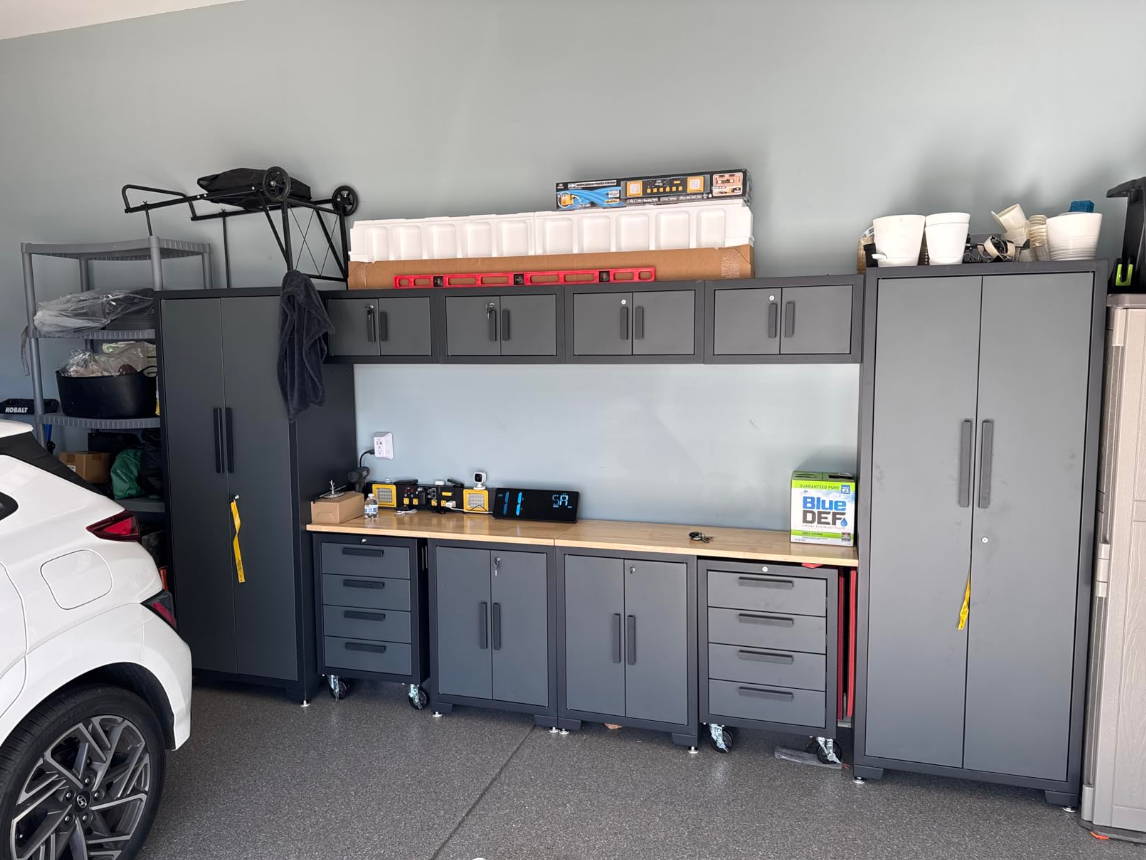
The photo above is a real owner’s installation. Notice what is happening. The tall lockers anchor both ends of the wall. The wall cabinets bridge the top, creating a continuous horizontal line. The base cabinets and rolling drawer chests fill the lower band, with the wood worktop running across the middle. Above the cabinets there is an open shelf zone for bulk storage. To the left, a wire shelf holds gear that does not fit in cabinets. This is a storage system. It is doing four different jobs at once: secure storage, working surface, frequent-access storage, and bulk storage.
A cabinet set alone cannot do this. A cabinet set fills the lower two-thirds of one wall and stops there.
What a complete garage storage system actually requires
There are five layers to a complete system. Most buyers underestimate three of them.
The first layer is enclosed storage. This is what most people think of when they say garage storage. Cabinets, lockers, drawer chests. The thing they protect from is dust, theft, and your own habit of stacking things on flat surfaces.
The second layer is a working surface. This is where the system becomes useful as a workshop instead of just decorative storage. A dedicated worktop, sized correctly and built strong enough to hold a vise or take impact, converts the cabinet bank from “place to put things” into “place to do things.”
The third layer is wall organization. The cabinet wall is not the only wall in your garage. The space above the cabinets and the wall opposite the cabinets needs its own organization strategy. Slatwall, pegboard, or wire shelving fill this role. A garage with one wall of cabinets and three blank walls is not a system. It is one finished wall surrounded by chaos.
The fourth layer is overhead storage. This is the layer most buyers skip and most regret skipping within two years. The space above seven feet in your garage is wasted by default. Overhead racks, ceiling shelves, or platform storage convert that volume into usable bulk storage for items you access twice a year — holiday decorations, camping gear, off-season tires.
The fifth layer is mobile organization. Rolling drawer chests, tool carts, and mobile workbenches that move with the project. This is the layer that determines whether your system feels like a workshop or feels like a storage closet.
A real system has at least four of these five layers. A cabinet set delivers one or two of them.
The three complete systems on Amazon worth considering
Of the three Amazon-available systems we recommend, two of them deliver three layers in a single purchase. One delivers two layers but is the right entry point for buyers on a tighter budget.
Torin 12-Piece System with Wood Workbench (Three Layers)
The Torin set is the closest thing to a complete system at the under-two-thousand-dollar price point. Twelve pieces deliver enclosed storage, integrated working surface, and mobile organization in a single purchase.
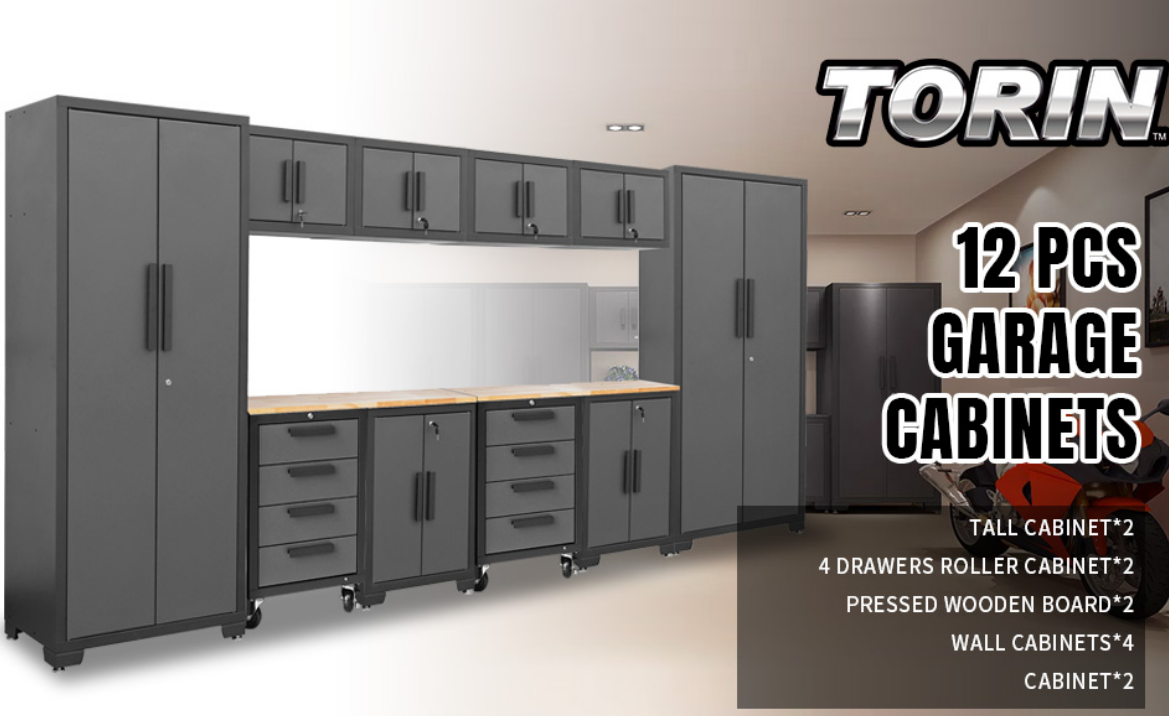
The configuration is two tall lockers, two four-drawer rolling cabinets, four wall cabinets, two two-door floor cabinets, and two pressed-wood worktops. The rolling drawer chests are the layer that most buyers underestimate. They give you mobile tool organization without buying a separate tool cart.
What the Torin set does not deliver is the wall organization layer above the cabinets and the overhead storage layer. You will need to add those separately. Slatwall panels run two hundred to four hundred dollars for a meaningful section. Overhead racks run one hundred fifty to three hundred dollars per rack. Plan for an additional five hundred to one thousand dollars to complete the system.
Check current Torin 12-Piece pricing on Amazon
HPDMC 15-Piece Corner System (Three Layers)
HPDMC delivers the same three layers as Torin, but with two additional features that matter if your garage layout is right for it.
The first additional feature is the corner geometry. The set is configured as an L-shape, which means it can use two adjacent walls instead of one. For garages with limited single-wall length but available corner space, this is a meaningful capacity gain. You get more cabinet volume per square foot of garage floor.
The second additional feature is the integrated pegboard. Four pegboard panels mount between the wall cabinets and the worktops, giving you immediate tool-organization surface area without needing to add slatwall separately. This delivers a meaningful piece of the wall organization layer in the same purchase.
The price premium over Torin is roughly one thousand dollars. Whether that premium is worth it depends entirely on your garage layout. If you have a corner to use, the HPDMC math works. If you only have a straight wall, the corner geometry is wasted floor space.
Check current HPDMC 15-Piece pricing on Amazon
VIYET 10-Piece Heavy Duty System (Two Layers)
VIYET is the entry point to a coordinated system at roughly fifteen hundred dollars. The set delivers enclosed storage and partial mobile organization. It does not include a worktop, which means it is missing the working-surface layer that makes a cabinet bank useful as a workshop.
The right way to think about VIYET is that it gives you the cabinet wall, finished and coordinated, at the lowest available price for a real branded system. From there you build the rest of the system one piece at a time. A separate worktop, a slatwall section, an overhead rack. The total spend over two years ends up similar to buying Torin in one purchase, but the cash flow is gentler.
VIYET is the right choice if you are converting your garage in stages or if you are unsure how heavily you will use the working surface and want to defer that decision.
Check current VIYET 10-Piece pricing on Amazon
How the three systems compare layer by layer
This is the comparison that matters for system buyers, and it is not a comparison the marketing pages will give you.
| Storage layer | VIYET 10-Piece | Torin 12-Piece | HPDMC 15-Piece |
|---|---|---|---|
| Enclosed storage (cabinets) | Yes | Yes | Yes |
| Working surface (workbench) | No | Yes (pressed wood) | Yes (pressed wood + corner) |
| Wall organization (slatwall or pegboard) | No | No | Partial (4 pegboard panels) |
| Overhead storage | No | No | No |
| Mobile organization (rolling chests) | Partial | Yes (2 chests) | Yes (multiple chests) |
| Layers delivered out of 5 | 2 | 3 | 3.5 |
None of the three sets delivers all five layers in a single purchase. To get to a five-layer system you will spend additional money on slatwall panels and overhead racks regardless of which base set you buy. The relevant question is which set gets you closest to complete in the first purchase.
What a typical complete-system buildout actually costs
The marketing pages all show the cabinet set installed in a magazine-quality finished garage. What the marketing pages do not show is the total spend to reach that level of finish. Here is the realistic math for a two-car garage with a single straight wall.
Cabinet set: $1,600 to $3,000 depending on which set you choose.
Slatwall section: $300 to $500 for an eight-foot by four-foot panel of premium PVC slatwall plus mounting hardware.
Slatwall accessories (hooks, baskets, shelves): $100 to $300 depending on how much you hang.
Overhead rack: $150 to $300 per rack, and most two-car garages benefit from two racks.
Floor coating (if you want the magazine-quality finish): $400 to $1,200 in materials for a DIY epoxy or polyaspartic coating.
LED workshop lighting: $150 to $400 for a real lighting upgrade beyond the stock garage door opener bulb.
Total realistic spend for a complete system, starting from a Torin base: $2,800 to $5,500 over six to twelve months. Starting from a VIYET base, the total is similar because the missing worktop layer has to be added separately. Starting from a HPDMC base, the total is two to three hundred dollars lower because the integrated pegboard reduces the slatwall spend.
This is not the budget the cabinet manufacturer wants you to think about. It is the real budget. Plan for it.
Bottom line
A garage storage system is a multi-purchase project, not a single product. The cabinet set you choose is the foundation, but it is not the whole system. The right way to buy is to plan all five layers up front, choose the cabinet set that delivers the most layers per dollar, and budget the rest as a planned second-phase spend.
If your budget for the first phase is under two thousand dollars and you want maximum flexibility for the second phase, buy VIYET. If your budget is around two thousand and you want a working surface from day one, buy Torin. If your budget reaches three thousand and your garage has a corner to use, buy HPDMC.
If you only have one wall and three thousand dollars total, do not buy HPDMC. The corner geometry will sit wasted, and you will have spent the premium for capacity you cannot use. Buy Torin instead, and put the saved one thousand dollars into slatwall and overhead racks.
The GarageKeep Review participates in the Amazon Associates program. If you click an affiliate link and complete a purchase, we may earn a commission at no extra cost to you. We do not accept payment for placement, and our editorial conclusions are independent of any commission relationship. See our Affiliate Disclosure for full details.