When mechanics waste fifteen minutes searching for a misplaced 10 mm socket or a 3/8” drive torque wrench, the root cause is rarely laziness. It is the failure of structural tool storage garage engineering. In a busy workshop or suburban family garage, tools without dedicated dimensional pockets inevitably accumulate in loose piles on worktops or inside unpartitioned plastic tubs.
A professional-grade tool storage system transforms chaotic workshop corners into high-efficiency mechanical bays. By integrating heavy-duty rolling chests, lockable cold-rolled steel lockers, and dual-density shadow foam organizers, you create a zero-friction maintenance workflow that protects thousands of dollars in hand tools & cordless equipment.
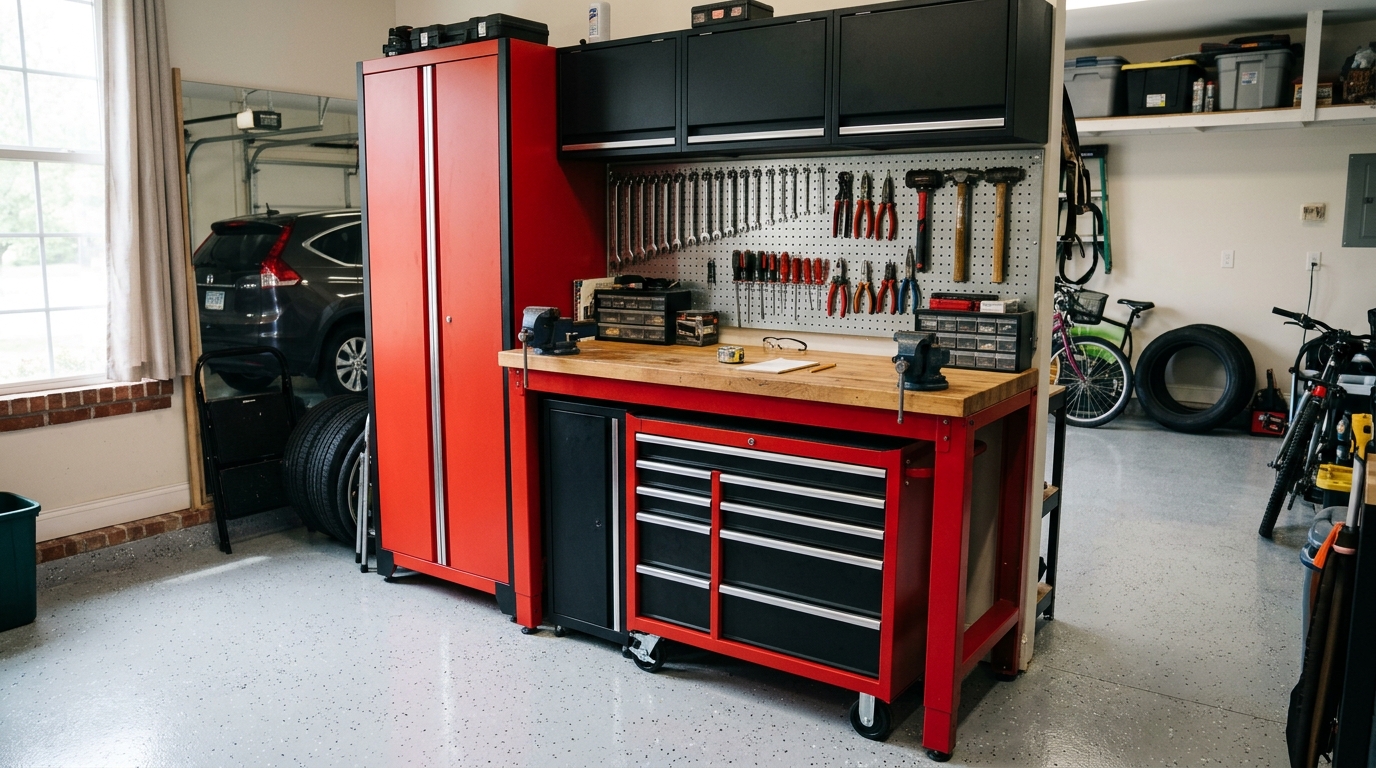
Structural Metallurgy: 18-Gauge Steel vs Lightweight Consumer Sheet Metal
The primary failure point of consumer tool chests sold at big-box home improvement stores is frame deformation under eccentric weight. When four bottom drawers are fully loaded with 1/2” drive impact sockets, cast-iron pipe wrenches, and pneumatic impact guns, total payload routinely surpasses 350 lbs.
Lightweight 22-gauge or 24-gauge (0.0299” thick) sheet steel flexes under this concentrated downward gravitational force. Once the outer frame goes out of square by even 0.060”, drawer slides bind against cabinet inner walls, stripping ball bearings from their tracks.
In contrast, commercial tool cabinets utilize 18-gauge to 16-gauge (0.0478” to 0.0598” thick) cold-rolled steel with reinforced hat-channel floor stiffeners and continuous corner welds. This structural rigidity maintains absolute squareness across decades of severe workshop duty cycles and temperature swings ranging from -15°F to 120°F.
Engineering Principle: When calculating gross workbench and chest capacity, never load drawers beyond 75% of rated slide capacity. A drawer slide rated for 100 lbs should carry a maximum static payload of 75 lbs to prevent track deflection and maintain smooth single-finger opening force.
Hardware Benchmarks: Comparing Tool Storage Architecture
Selecting the right balance between mobile chest mobility, tall locker vertical capacity, and fixed workbench architecture dictates long-term workshop productivity.
| Technical Specification | Heavy-Duty Rolling Tool Cabinet | Multi-Door Welded Steel Locker | Consumer 22-Gauge Tool Box |
|---|---|---|---|
| Steel Gauge Thickness | 18-gauge cold-rolled steel (0.0478”) | 18-gauge to 20-gauge welded steel | 22-gauge to 24-gauge sheet metal |
| Drawer Slide Rating | 100 to 120 lbs (dual slides on deep drawers) | Integrated shelves rated 150 to 200 lbs | 35 to 50 lbs friction or basic ball-bearing |
| Caster Specifications | 5”×2” polyurethane with 360° toe locks | Stationary threaded leveler legs (M10/M12) | 3” hard plastic wheels (flat-spot prone) |
| Anti-Tip Interlock System | Single-drawer opening safety interlock | Wall stud anchoring brackets required | None (severe tip hazard if multiple open) |
| Total Weight Capacity | 1,500 to 2,200 lbs gross vehicle weight | 1,000 to 1,400 lbs total load rating | 300 to 500 lbs total static capacity |
| Installed Price Band | $450 to $1,250 depending on tier count | $380 to $850 per 36” wide tall locker | $150 to $280 for entry consumer units |
For full workshop overhauls requiring synchronized work surfaces and rolling storage, comprehensive multi-piece suites like the Torin 12-Piece Garage Cabinet Suite provide factory-welded 18-gauge steel framing, hardwood tops, and full-extension drawer slides built for rigorous commercial workloads. If your floor plan requires specialized corner layout options, examine our detailed Torin 12-Piece Garage Storage Cabinet System Review as well as our deep dive into garage cabinet storage heavy duty systems.
Precision Foam Shadowing: Visual 5S Discipline for Hand Tools
The most effective method to eliminate missing hand tools is two-color closed-cell polyethylene (PE) shadow foam. Originally pioneered in aerospace maintenance facilities, foam shadowing provides immediate visual feedback: if a tool is in use or missing from its nest, a bright red or high-visibility yellow contrast base layer signals an open pocket across the shop floor.
To execute a custom drawer shadow layout:
- Sort by Frequency of Use: Place high-frequency 1/4” and 3/8” ratchet drivers and standard metric sockets in the top 2.5” shallow drawer, keeping specialty pullers and pry bars in lower 6” drawers.
- Trace with Precision Clearance: Lay out tools with a minimum 0.75” bridge between adjacent items to maintain foam wall integrity. Trace outer tool profiles using a surgical craft scalpel held at 90° vertical.
- Cut Finger Notches: Always cut dual semi-circular finger relief pockets on opposing sides of heavy pliers and ratchets to allow rapid single-hand removal without prying.
- Thermal Bonding: Bond the 0.50” upper dark foam layer to the 0.125” contrast bottom backing sheet using low-temperature solvent-free spray adhesive to prevent chemical bubbling.
Floor Levelling and Mobile Caster Dynamics
Garage concrete slabs are engineered with a compulsory 1.5% to 2.5% drainage slope away from the interior foundation toward the driveway door. Placing a 600 lb mobile tool chest on an inclined concrete floor creates a rolling safety hazard if caster brakes are inadequate.
Always verify that mobile cabinets feature at least two directional swivel casters equipped with positive dual-locking mechanisms that simultaneously brake wheel rotation and lock the 360° swivel pivot. On stationary tall locker runs, adjust heavy-duty threaded steel leveling feet using a 48” magnetic box level, ensuring cabinet door reveal lines remain perfectly parallel with zero face-frame racking.
Integrating durable cold-rolled cabinetry and structured tool storage garage layouts eliminates clutter, accelerates vehicle repair turnarounds, and safeguards your mechanical tool investments for decades.