Clearing the perimeter floor of gas-powered string trimmers, extension ladders, steel leaf blowers, and extension cord bundles requires hanging equipment vertically. However, haphazardly screwing individual zinc hooks into bare drywall or guessing stud locations inevitably results in popped drywall screws and damaged automotive paint beneath falling tools.
Modern garage wall storage systems solve vertical hanging through two primary mechanical methodologies: continuous horizontal steel track rails and modular tongue-and-groove panel channels. Both transform weak gypsum wallboard into an active structural matrix capable of supporting hundreds of pounds per linear foot through extreme thermal swings from -20°F to 125°F and relative humidity fluctuations of 20% to 95%. They deliver commercial-grade durability & finish while keeping equipment elevated off damp concrete slabs.
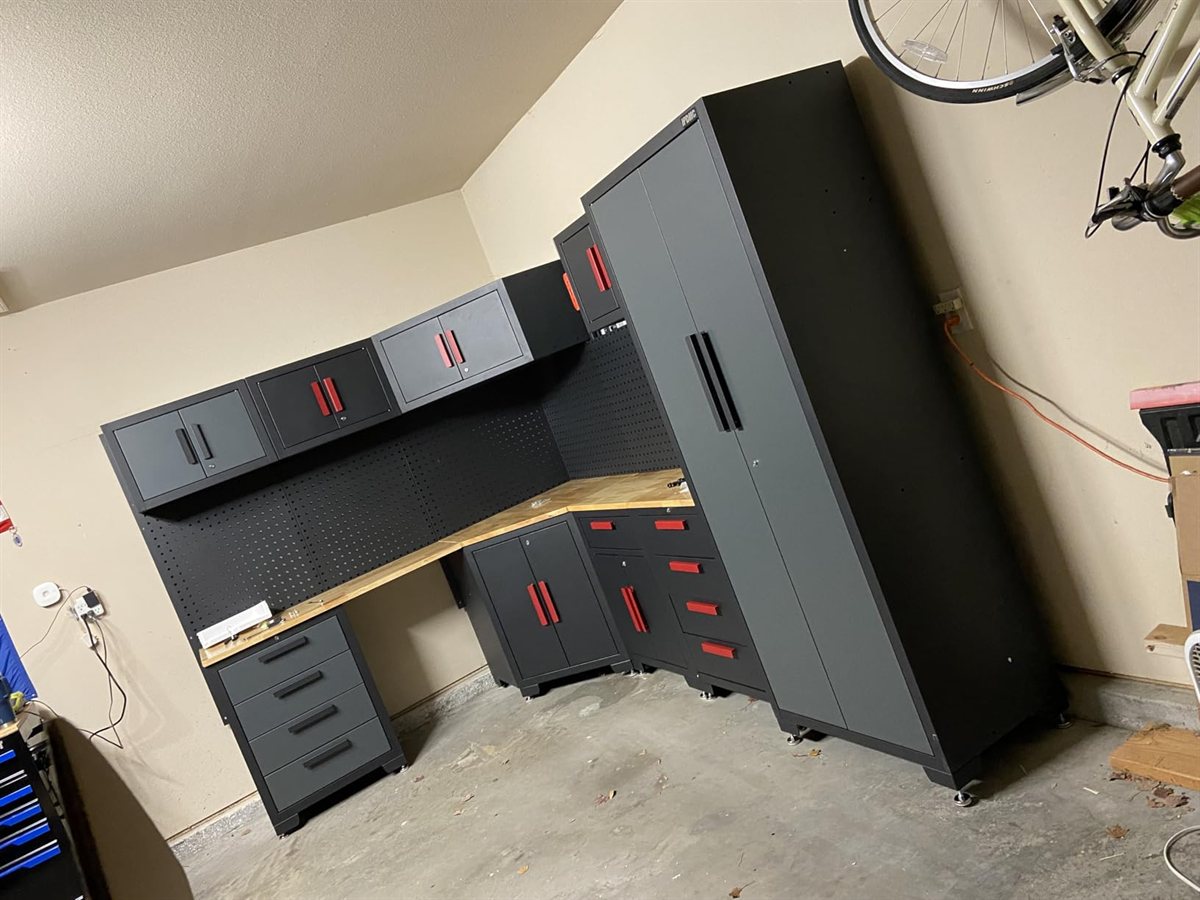
Mechanical Load Transfer: How Wall Track Systems Function
The reason a dedicated garage wall organizer track rail outperforms individual hardware store hooks comes down to shear load distribution.
When you hang a 32 lb commercial backpack leaf blower from a single drywall screw, the downward gravitational force acts on a localized shear plane with zero lever-arm resistance. In contrast, an extruded steel or aluminum horizontal track rail spans across multiple vertical wall studs spaced on 16” or 24” centers.
Fastener Shear vs Tension Mechanics
- Shear Force: The downward gravitational pull exerted by hanging tools. Wood studs in residential construction provide approximately 150 to 220 lbs of allowable shear load per #10×2.5” wood screw embedded 1.5” into sound Douglas fir or spruce framing.
- Pull-Out (Tension) Force: The outward cantilever force generated when a heavy ladder or hose reel extends 12” to 16” away from the wall plane. A horizontal track rail distributes this rotational torque across the upper flange of adjacent stud fasteners, preventing individual anchors from working loose.
Fastener Rule: Never install horizontal track rails or heavy-duty wall organizers using plastic toggle anchors or drywall expanding bolts. Every mounting hole must be driven through the center of a structural 2”×4” wood or light-gauge steel stud using #10 or 1/4” hardened cabinet screws with at least 1.75” of direct stud thread penetration.
Comparison: Horizontal Steel Tracks vs Full-Coverage Slatwall
Choosing between a targeted horizontal track rail (such as Rubbermaid FastTrack or Gladiator GearTrack) and a full-coverage cellular PVC slatwall depends on tool density, wall real estate, and project budget.
| Performance Attribute | Extruded Steel Track Rails | Cellular PVC Slatwall Panels | Heavy-Duty Steel Wire Wall Shelves |
|---|---|---|---|
| Material Base | Cold-rolled powder-coated steel | High-density cellular PVC extrusion | Welded cold-drawn steel wire |
| Linear Weight Capacity | 1,200 to 1,750 lbs per 48” rail | 65 to 75 lbs per square foot | 400 to 600 lbs total per shelf |
| Stud Spacing Flexibility | Mounts to 16” or 24” on-center studs | Requires uniform 16” stud centers | Requires uniform 16” stud centers |
| Primary Tool Profile | Long-handled tools, bikes, ladders | Hand tools, spray bottles, small parts | Storage totes, car batteries, oil jugs |
| Hook Locking Mechanism | Positive cam-lock or push-pin latch | Gravity drop-in groove lip | Fixed welded bracket clamps |
| Installed Cost / Lin Ft | $12.00 to $18.00 per linear foot | $28.00 to $45.00 per linear foot | $22.00 to $35.00 per linear foot |
For garages requiring high-density hanging for heavy gear—like 28-foot fiberglass extension ladders, mountain bikes, or gas pole saws—horizontal steel track rails deliver the highest weight-to-dollar ratio. For comprehensive workshops where you want magnetic tool bars, small bin trays, and cordless drill holsters covering an entire 8’×10’ partition, full-coverage slatwall panels offer superior modularity.
Selecting Hook Hardware and Locking Mechanisms
A horizontal wall rail is only as dependable as the locking hardware holding tools onto the track profile. Cheap hook accessories rely on simple friction or gravity hooks that slide laterally or lift off the track when you pull a shovel or rake away from the wall.
High-grade wall organizer accessories incorporate three specific engineering features:
- Positive Cam or Snap-Lock Clips: Heavy-duty hooks feature an integrated nylon or spring-steel locking latch that clicks securely over the top rail flange. When you lift a hedge trimmer off the hook, the hook stays firmly anchored to the rail.
- Vulcanized Rubber / Vinyl Cushioning: Bare steel hooks scratch aluminum ladder rails and damage powder-coated bicycle wheel rims. Look for industrial dip-coated or vulcanized textured rubber grips that prevent tool slippage and isolate vibration.
- Double-Arm Cantilever Geometry: Single-prong J-hooks tend to twist along their vertical axis under asymmetric loads. Dual-arm cradle hooks provide two contact points spaced 3” to 8” apart, keeping bulky equipment perpendicular to the wall plane.
For a battle-tested industrial track foundation, the Rubbermaid FastTrack Garage Storage System offers heavy-gauge stamped steel rails capable of handling 1,750 lbs across 48” spans, backed by push-button locking accessories. If you prefer full-coverage wall paneling, read our side-by-side analysis in Gladiator GearWall vs Proslat Garage Slatwall Review and our comprehensive guide to the best garage wall storage systems.
Proper Wall Preparation and Electrical Stud Mapping
Before driving fasteners into garage drywall, mapping hidden infrastructure is critical. Garage utility walls frequently carry 120V/240V high-amperage electrical conduits for air conditioning condensers, sub-panels, and EV charging stations, as well as 0.75” copper plumbing or PVC drain lines.
Take these preventative measures:
- Use an Electronic Multi-Scan Detector: Scan along your planned track centerline for both deep wood studs and live AC wiring. Most residential plumbing and wiring pass through the center of 3.5” deep studs at 1.75” elevation, protected by steel nail plates. If your drill bit hits hard metal resistance at 1.25” depth, stop drilling immediately.
- Pre-Drill Pilot Holes: Always drill a 1/8” pilot hole into wood studs. Pre-drilling prevents dense structural lumber (like dried Douglas fir) from splitting along its grain when a #10 structural lag screw is driven home.
- Level with a 48” Precision Spirit Level: Snap a level chalk line across all stud locations. Running horizontal rails out of level causes multi-hook equipment to slide downward under vibrational load.
With proper anchoring into structural studs, garage wall storage systems reclaim dozens of square feet of valuable floor area, keeping tools accessible while safeguarding vehicles from accidental scrapes and falls.